
Who Shapes Whom!
When a bolt from one manufacturer fits a nut from another, there is rarely much to celebrate. It is supposed to fit. If it does not, a small item can delay a much larger assembly.
That simple expectation depends on people who may never meet agreeing on dimensions, tolerances and the meaning of a designation. The designer can select the parts without separately negotiating how each supplier will make them. Much of engineering works because such agreements already exist.
Yet fitting together is only the beginning. The bolt must also be suitable for the joint, and tomorrow’s design may need something today’s agreement does not cover. Standards help engineers build on established knowledge while making the consequences of changing it more visible. To understand that relationship, it helps to follow the problem that first makes standardization useful: how do people working separately produce something that works together?
When work must fit together
Builders needed common dimensions long before modern factories. A wall assembled from repeating units is easier to plan when those units follow a familiar proportion. The Harappan civilization, spread across parts of present-day India and Pakistan, left evidence of such a convention. Many of its bricks had an approximate length-to-width-to-height ratio of 4:2:1. Regional variations existed, so this was a recurring proportion rather than a universal brick size. [1]
For an engineer looking at that evidence, the practical advantage is easy to recognise. A common proportion gives craftsmen a predictable starting point. Each brick can be made separately, yet contribute to an arrangement understood by the person building the wall. Agreement reduces the decisions that must be made again at the site.
Shared dimensions, however, require a shared way of measuring them. Ancient Egyptian cubit rods gave physical form to a unit of approximately 52 cm. The Museo Egizio preserves a royal cubit rod measuring 52.4 cm and describes a folding rod probably used by its owner at work. [2] A measure associated with the human arm became a reference that could be carried, consulted and communicated.
The bricks and rods address two connected needs: repeatable proportions and a common measure. Those needs survived into industrial production. What changed was the distance between the people who had to agree, and the number of products that depended on their agreement.
Agreement across borders
Production and trade crossed national boundaries, exposing the limits of agreements made within individual workshops and countries. International cooperation offered a way to agree across borders, but war would test the ability to sustain it.
The International Federation of the National Standardizing Associations, known as ISA, was established in 1926. The Second World War disrupted its activities; ISO’s historical account records that ISA later regarded itself as having ceased to exist in 1942. In 1944, the United Nations Standards Coordinating Committee, or UNSCC, was established to support the war effort and reconstruction. [3] War had interrupted one arrangement while creating an urgent reason for another.
The challenge after the war was to establish broader cooperation. Representatives from 25 countries met in London in October 1946, and ISO officially came into existence on 23 February 1947. [3,4] Its name reflects the same concern for consistency: ISO explains the universal short form through the Greek word isos, meaning equal, avoiding different initials for the organization’s name in different languages. [5]
For engineers, an early result of that cooperation was an agreement about measurement itself. ISO’s first published recommendation, ISO/R 1:1951, concerned the reference temperature for industrial length measurements. [4] A drawing can specify a dimension precisely, but comparing measurements also requires agreement about the conditions under which they are made. The ancient need for a common reference had acquired a more exact form.
Arriving at that form requires more than recording a popular practice. ISO describes a process of expert drafting, comments, discussion and voting, with participation from industry and other stakeholders. [6] The process turns experience and proposals into requirements that others can interpret and apply. It also makes room to question whether a familiar practice is suitable for the proposed scope.
Once published and adopted, an agreement begins to influence the decisions of people who were never part of those discussions. That influence can become especially strong when many connected systems depend on the same choice. Railway history shows what is at stake.
When a useful choice becomes hard to change
Railway standard gauge is 1,435 mm, or 4 ft 8½ in; India’s broad gauge is a different dimension, 1,676 mm. [7,8] The persistence of a gauge matters because vehicles and tracks must remain compatible over an entire network.
The 1,435 mm dimension has attracted a memorable origin story linking railways, horse-drawn vehicles and Roman chariots. Researchers have measured ancient wheel ruts and proposed a connection with modern railway gauge. [9] The resemblance is interesting, although measurements alone cannot establish an uninterrupted historical chain or prove that railway designers deliberately adopted a Roman dimension.
A documented difficulty is more revealing. A parliamentary record from May 1846 includes a petition from passengers travelling between Birmingham and Bristol who complained about the break of gauge. [10] Whatever the merits of each railway’s choice, their incompatibility had become a problem for the people trying to travel between them.
A dimension that works for one railway therefore has to be judged differently once the railway joins a network. Changing it affects tracks, rolling stock and the equipment built around them. Compatibility becomes a reason to retain an established choice, even when a designer starting with an empty site might choose differently. This influence of earlier decisions is often called path dependence.
There is a real benefit here, as well as a constraint. A stable interface lets many people invest and build with confidence. The same investment makes later change difficult. The useful question is how to preserve that confidence while giving a better idea a fair opportunity to demonstrate its value.
Making room for the next idea
Consider how an idea can reach the point at which others depend on it. It is developed into a product, tested and adopted more widely. As its use spreads, people need common definitions, interfaces and ways to assess performance. Experience can then inform a standard. Following that standard makes the product easier to use within a larger system, until new needs or better ideas prompt another round of development.
This cycle helps explain why innovation and standardization keep influencing each other. It also explains why the order can vary. A standard may develop alongside an emerging technology, and an agreed interface may enable an improvement that could not otherwise reach users. A manufacturer can change the internal design of a component while retaining the connection that allows it to work with existing equipment.
Common tests can help that manufacturer demonstrate the improvement. The new design and the established design can be assessed against the same defined outcome. Where suitable, requirements expressed in terms of performance leave room for different solutions. A requirement prescribing a particular solution may need reconsideration when another approach becomes viable.
Figure 1 presents this relationship as a simple feedback loop, although individual technologies may move through the stages in a different order.
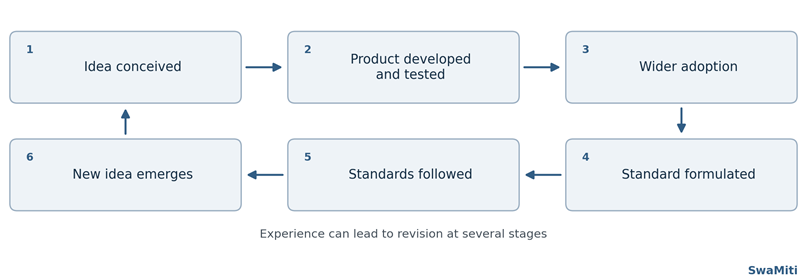
Figure 1 A conceptual cycle linking innovation and standardization
The cycle continues only if experience returns to the people developing the requirements. Test results, manufacturing difficulties and behaviour in service provide reasons to confirm a standard or revise it. A published agreement captures a position reached at a particular time; its continued usefulness depends on whether the evidence still supports it.
The engineer at the drawing board
This brings us back to the bolt. Agreement about its thread allows it to fit the nut. Selecting it for a transformer tank joint requires further judgment about strength, coating, tightening conditions and the behaviour of the joint. The convenience of a standard designation does not settle those questions.
Transformer engineering brings many such interfaces into one assembly, where electrical clearances, mechanical strength and oil-tight sealing must work together. IEC 60076-1 establishes general requirements for power transformers within its scope. [11] A project also draws on requirements for materials, accessories, manufacture and testing. The designer has to connect them to the actual equipment, using the documents and editions that govern the project.
At a bushing mounting, electrical suitability must be considered alongside mechanical fit and the loads at the interface. During transport and installation, equipment design has to connect with the intended handling method and foundation conditions. These examples illustrate application judgment: requirements drawn from different sources have to work together in the physical assembly.
A scope statement therefore deserves as much attention as a numerical limit. The engineer must establish whether the equipment, loading and environment fall within the conditions addressed by the requirement. A successful test provides evidence under its stated conditions; its relevance to the intended service still has to be understood.
Even a small word can affect that understanding. In ISO’s drafting conventions, shall indicates a requirement and should a recommendation. ISO also makes clear that its standards are voluntary and do not replace national law. [12] For a project, the engineer must still establish the requirements that apply through the specification and applicable rules, and resolve any proposed departure through the project’s agreed process.
For a young engineer, learning to make these connections is part of learning to design. It begins with asking what problem a clause addresses, then checking its definitions, conditions and referenced documents. When experience exposes a gap, a clear record of the problem can help others evaluate it. That is how someone applying a standard can also contribute to its improvement.
World Standards Day, observed on 14 October, recognises the experts who develop international standards. [13] Their work makes it possible for engineers separated by distance and time to build on a common foundation. The responsibility passes to each engineer who uses it: to understand the agreement, judge its application and return evidence when it needs to change.
The bolt should fit. The designer must decide whether it belongs in that joint, supporting the choice with rigorous evidence. When that evidence refines the shared rules, today’s engineering becomes part of the standard on tomorrow’s drawing.
References
Sources are listed in order of first mention. The cycle diagram presents a conceptual relationship rather than a mandatory sequence.
[1] Khan, A. and Lemmen, C. Bricks and urbanism in the Indus Civilization. 2013. Discussion of brick proportions and regional variation. Open source
[2] Museo Egizio. Royal cubit rod inscribed with the name of pharaoh Amenhotep II. Collection record Suppl. 8647. Open source
[3] ISO. Friendship among Equals Recollections from ISO’s First Fifty Years. 1997. The Founding of ISO, printed pages 15–18. Open source
[4] ISO. ISO celebrates 70 years. 23 February 2017. Founding and first published recommendation. Open source
[5] ISO. About ISO. Explanation of the universal short name ISO. Open source
[6] ISO. Developing standards. Market need, expert committees and consensus process. Open source
[7] National Railway Museum. Back to the future as history made with east coast rail icons. 24 April 2017. Standard gauge dimensions. Open source
[8] Indian Railways RDSO. Track Relaying Train for Broad Gauge 1676 mm. Technical specification. Open source
[9] Ogata, M., Tsutsumi, I., Shimotsuma, Y. and Shiotsu, N. Origin of the world’s standard gauge of railway is in the interval of wheel ruts of ancient carriages. JSME conference proceedings, 2006, pages 98–103. Cited as a proposed historical connection. Open source
[10] UK Parliament. Hansard House of Commons, 28 May 1846. Petition concerning the break of gauge on railways. Open source
[11] IEC. IEC 60076-1 Power transformers Part 1 General. Catalogue abstract and scope. Open source
[12] ISO. Foreword Supplementary information. Voluntary status and relationship with national law. Open source
[13] ISO. World Standards Day. Open source
Found an error, have an improvement, or want us to cover a related topic?